
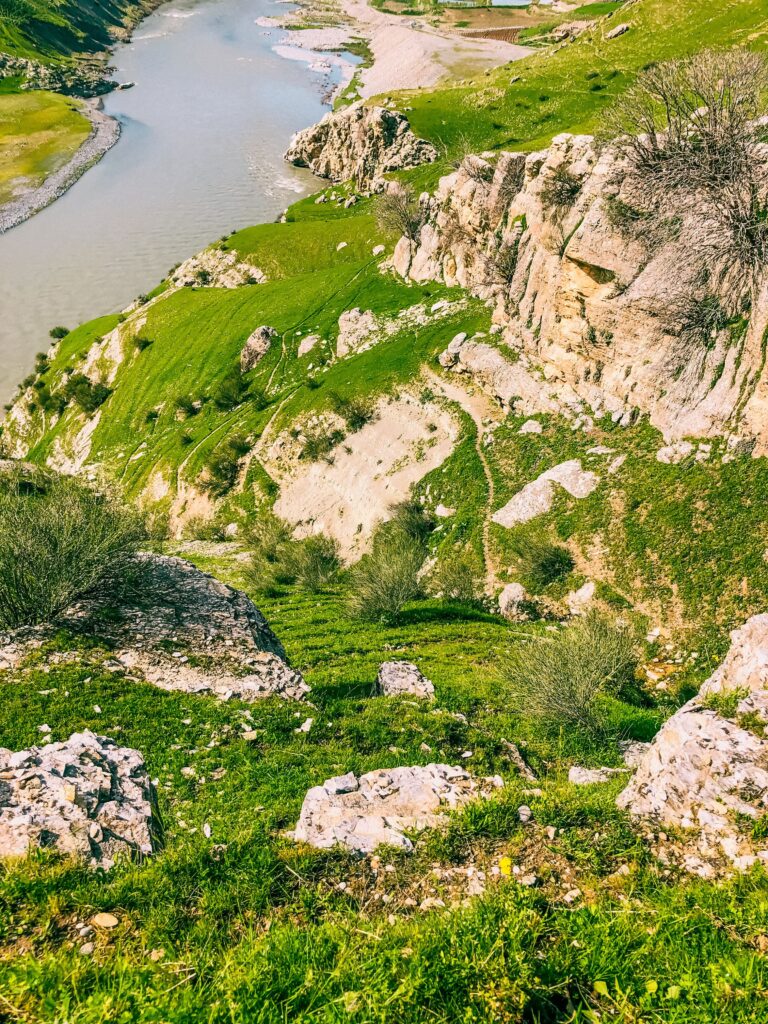
“The same night [Jacob] arose…and crossed the ford of the Jabbok“
Genesis 32:22
On a sunny day, it is a joy to sit on the shore of a sparkling river and savour the water’s movement. The river’s mood can change drastically, from a gentle flow of soft greens to the rapid, unpredictable flow of a murky brown spring melt or stormy downpours. These moods can capture our attention so completely that we may not even notice the view on the other side. The shoreline and terrain on the other side are simply a backdrop.
But what if the other side is more than a backdrop and it matters? What if getting to the other side matters more than the view? And what if that river, in all its present beauty, is really a barrier to what truly matters on the other side? What if there is a destination, a task, a calling on the other side, and the river is an obstacle that requires a crossing with no easy way?
Think of the whole nation of Israel, after travelling through the difficult wilderness, finally arriving at the shore of a flooded, harvest-time Jordan River. Their final destination, however, is on the other side of that massive barrier. What is that destination, waiting there, out of reach? A land rich and beautiful. Promises and a future. Purpose and a destiny.
Or think of Jacob camped at the Jabbok, a tributary that leads to the Jordan River. This ford was a boundary line where he hesitantly camped after a long journey back, delaying his crossing by one more night. What was on the other side of that ford? A task enclosed by a promise and the next chapter of Jacob’s journey with his God of promise. For Jacob, that crossing became a place of transition, of a deeply transformative encounter with God, and of a name change. Here, Jacob became Israel. What steps did he choose that brought him to this all-night crossing of a river ford?
One cannot cross that river to the more that God has for us except to approach the river, go down to that shore, and see what happens in that time and place. It’s easier to stand and enjoy the river and the promising land on the other side from a distance, vaguely aware of the descent to the shore, and say, “How nice.” “What beauty You have created, Lord.” “The Kingdom of God looks so amazing!” But to actually approach that crossing and choose to go down – that really is your steps of faith and trust and hope. To press in to that descent and accept the humility of the unsteady downward steps, to take on the hard of His timing and His pruning, when there is no turning back, so that we can embrace His kingdom promises more fully and enter into the dreams He’s nurturing in us… that requires perseverance and encouragement along with faith and hope, no matter how faint.
I know, because that is where I am at right now. How low, Lord? How long? Until the dry path in the water?
Thus says the LORD, who makes a way in the sea,
a path in mighty waters,…
Behold, I am doing a new thing….
Isaiah 43:16, 19
What does the Lord say to you? In the midst of this, what new thing is He revealing, offering, extending? What Kingdom promises and dreams lie before you? Is there a path down that God is calling you to? What is that path within loss, grief, the hard? Is there forgiveness to be extended? Is there old thinking, lies you have believed, that you need to step down and away from? Replacing them with truth and freedom? Is there hidden pride (it’s sneaky, you know) to kill? Small steps of trusting? Sacrificing steps of praise and gratitude?
Let’s pause for a moment on this small verse (below) in the middle of a significant God-sized transition in a nation:
When you come to the brink of the waters of the Jordan,
you shall stand still in the Jordan.
Joshua 3:8
When you come to the brink….
How many downward steps did the nation of Israel take before they got to this moment of now standing at the brink? That moment long awaited. Read it again. Interesting that the word is “come,” not “go.” It hints that the Lord goes before us and wants us to follow. And that word “come” is an action verb, implying movement. It’s a movement toward something, not away from something else. This encouragingly suggests that such movement has deep purpose and is not wasted. What a fascinating Kingdom word that offers such an invitation and hope for us! (Find more on “come” here.)
The word “brink” is the Hebrew word qatseh. This word means “an extremity.” An extremity can be the farthest point, or the greatest degree, or it can mean distress and grave danger. I found that of the ways it is used in Scripture, two caught my attention: it can express the borders of a covenant land or refer to remote places, all under God’s universal rule.
Do you sense the encouragement for this season to take those daily steps to a river’s edge, a brink? That those steps lead you to something? As we draw nearer to the edge of the river, that downward path, making those daily choices, it is both our extremity, our end, and a border of something new that we are approaching.
The Lord knows of your extremity, of my extremity. He knows that journeying in that obedient direction requires much: surrender and trust and, not least, perseverance and endurance. That extremity has likely included danger, or the sense of danger. But He’s bringing us to a border. And not just any border! A new border to the “more” that is on the other side. To more of Him and the Kingdom.
If this is the path you are on, know that I am walking with you. Somewhere else on the river, I am choosing to step down. I am stepping away from old thinking and towards new. I confess, though, that sometimes my faith wavers or fear leaps out at me; I retreat and retrace a few steps; Or, I halt and stand, stuck. But through His grace, despite weariness at times, I am, overall, approaching that river that will lead to a border crossing.
How we need Him!
Talk with Him
Pray about your downward descent. Confess your struggles. Speak the promises you’ve received, dreams you have. Praise Him and ask Him What do you want me to know in this season? And listen.
Further Study
- The very name Jabbok, that Jacob crossed, or Yabbaq, means “a pouring forth.” It comes from a root word meaning “to empty.” Do you think these mean the same thing? Open your Bible to Genesis 32:22. Read the chapters leading up to this point in Jacob’s life and compare them with what is revealed in the chapters following this transition. What brought Jacob to the brink of this ford? What might the Lord want you to know?
- Read about Israel’s crossing of the Jordan River in Joshua 3. That passage hides SO much. Ask the Lord to reveal His truth to you at the edge of your river. For example: What does it mean to stand still in the Jordan? Why both the words “stand” and “still”? Doesn’t standing imply stillness? What does “Jordan” mean? Does this surprise you?
We are at the brink. Thank you, dear Annetta, for the insight that we have not ‘gone’ to the brink but that in fact we have ‘come’ to the brink with our Lord of love. That He has gone before us to this brink and He will bring us through the waters, they will not overwhelm us. There is precious and eternal purpose in the road down to the brink. We ourselves would never choose the way down, and so we are grateful that the Lord of heaven and earth is our Lord, our Sovereign. He chose it for us because He loves us and desires to strip us of what is not of Him and build in us deep faith, wholehearted love and devotion for our Saviour. Such precious and eternal fruit would never be produced without His purposeful pruning.